
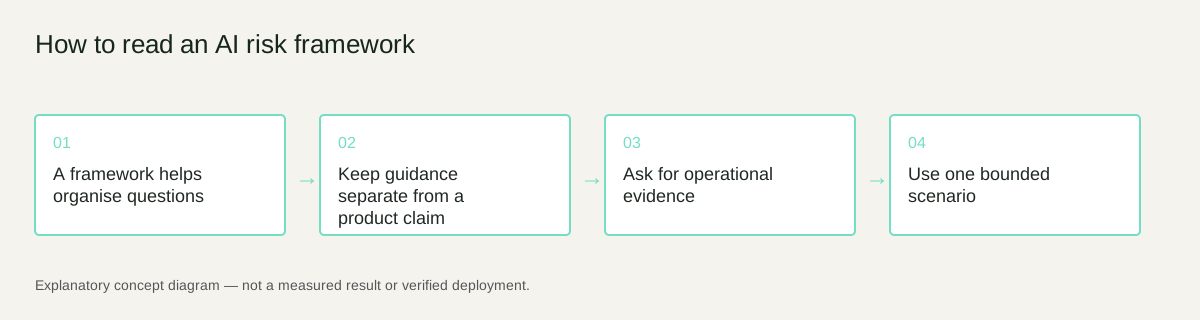
A framework helps organise questions
A risk framework can give a team a shared way to describe responsibilities, context and evidence. It is not automatically a completed risk assessment. Reading its vocabulary is useful, but a product review still needs to identify which practices were actually performed and what records support that account.
Keep guidance separate from a product claim
NIST’s AI RMF and its accompanying playbook are public resources for thinking about AI risk management. Referencing them does not show that a product follows them, and using their names in marketing does not create a certification. Explain which part of the guidance is relevant to the research question. [C06][C08]
Ask for operational evidence
If a team claims to manage a risk, ask what decision was made, who owns it, which test informed it and how a later change triggers review. These are research questions, not a demand to disclose confidential internal information. A publication can record that evidence was not available without inventing the missing answer.
Use one bounded scenario
Imagine a summarisation tool that occasionally omits a qualification from a source. A useful review might examine detection, escalation and correction practices for that failure. Merely placing the tool within a diagram of a framework would not establish that those practices operate.
Publish a clear boundary statement
Describe the framework, the selected question and the available implementation evidence separately. Avoid claims of compliance or safety that outrun the work performed. Where expert review is needed, keep the status pending until an actual qualified reviewer has assessed the material.
Sources
- NIST AI Risk Management Framework — Risk-management guidance; not product certification.
- NIST AI RMF Playbook — Suggested practices; implementation requires its own records.
Sources and further reading
- NIST AI Risk Management Framework ↗
Risk-management guidance; not product certification
- NIST AI RMF Playbook ↗
Suggested practices; implementation requires its own records
Check the original document for its scope, date and current status.
Something needs a closer look?
Suggest a correction