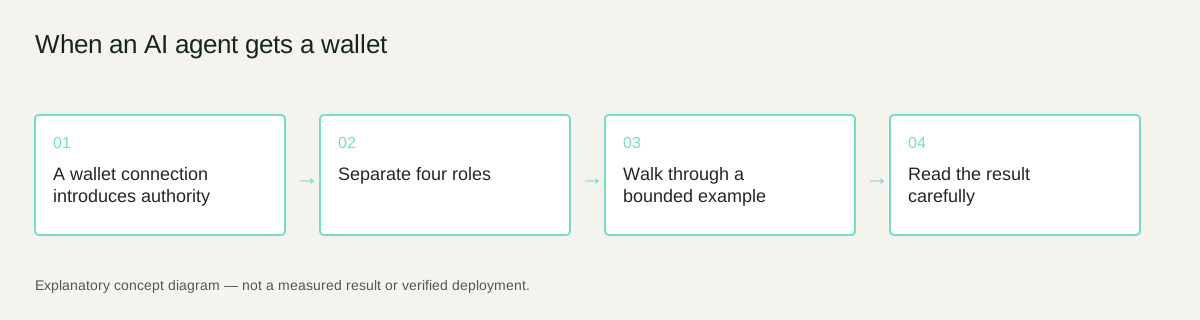
A wallet connection introduces authority
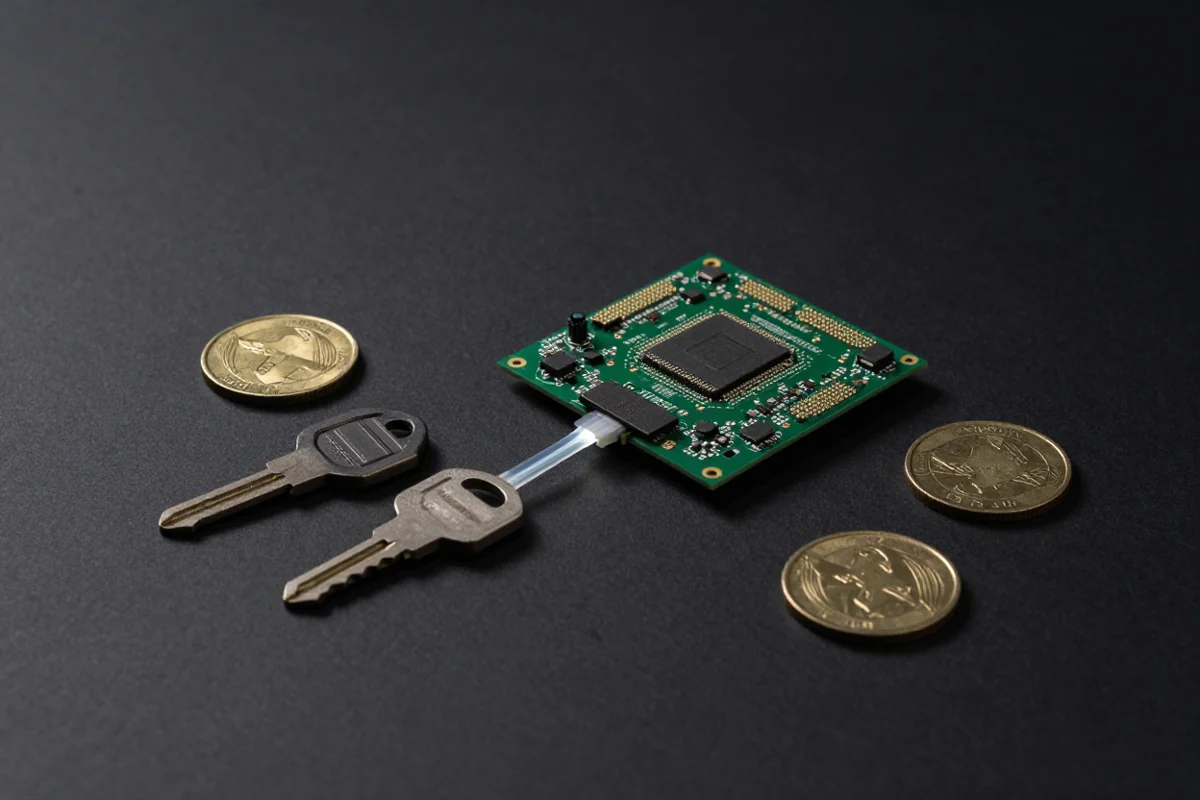
An AI agent that can prepare a payment has a different role from a system that can sign one. Before describing a product as autonomous, separate the instruction, the decision process, the signing mechanism and the transaction. A useful explanation identifies where each responsibility sits. It does not collapse the entire process into a picture of an agent holding a wallet.
Separate four roles
Start with the person or organisation setting the task. Then identify the software interpreting the request, the service managing access to signing keys and the network receiving the transaction. Ethereum’s account documentation explains accounts and transaction authority; it does not establish how a particular AI product implements its controls. That requires product-specific documentation and, where available, observable tests. [C01]
Walk through a bounded example
Imagine a research assistant allowed to purchase access to one document. This is an illustrative workflow, not a claim about an existing service. Write down the permitted recipient, maximum scope, expiry and approval requirement. Ask what happens when the assistant selects another recipient or repeats a request. A screenshot of one successful purchase cannot answer those exception questions.
Read the result carefully
A transaction record may help establish that an action reached a particular network. It does not, on its own, prove that a model understood the task, that the purchase was useful or that the operator consented to every step. Keep a separate record of the instruction and permissions. If those records are unavailable, describe the limitation instead of assigning an autonomy score.
Questions to ask next
Who can revoke access? Can a task run twice? Which service reports a failure, and does it distinguish a proposed action from a signed one? Keep these questions with the source record so a later reader can repeat the reasoning. This article explains a research approach; it does not recommend using an agent or transferring funds.
Sources
- Ethereum accounts — Account types and transaction authority; not product assurance.
- Introduction to smart contracts — General program model; not a deployment audit.
- NIST AI Risk Management Framework — Risk-management guidance; not product certification.
Sources and further reading
- Ethereum accounts ↗
Account types and transaction authority; not product assurance
- Introduction to smart contracts ↗
General program model; not a deployment audit
- NIST AI Risk Management Framework ↗
Risk-management guidance; not product certification
Check the original document for its scope, date and current status.
Something needs a closer look?
Suggest a correction