

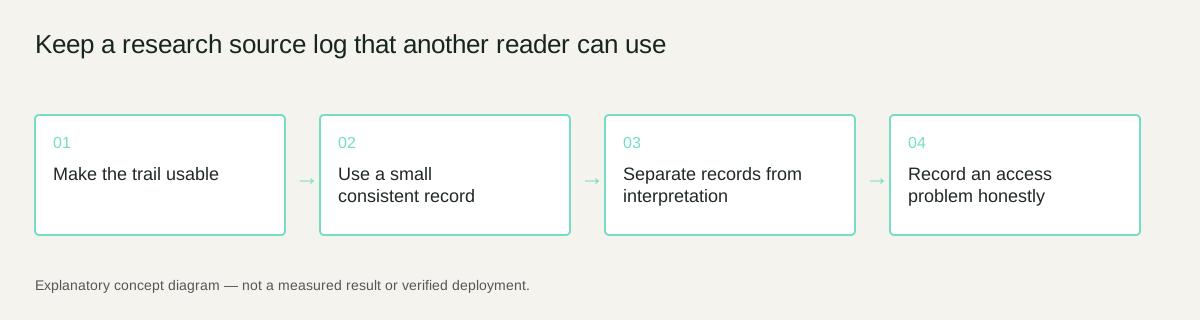
Make the trail usable
A source log is valuable when another reader can repeat the route from a sentence to its supporting material. A list of attractive links is not enough. Record what each source supports, where the relevant passage sits and which limits affect the conclusion.
Use a small consistent record
Keep the title, publisher, URL, document status, source date, observation date and a short evidence note. A missing date should remain unknown rather than being replaced with the date you opened the page. Where a page is versioned, retain the version reference alongside the readable title.
Separate records from interpretation
Place a short description of the source in one field and the publication’s interpretation in another. For example, an account-model document describes a mechanism, while a research article may use that mechanism to frame questions about an agent’s permissions. The Ethereum account documentation is a concrete example of a technical reference, not an endorsement of that interpretation. [C01]
Record an access problem honestly
If a link cannot be opened during review, preserve the access result and seek another accessible primary record. Do not silently replace the source with an unsourced summary. When the missing document is essential to a claim, keep the claim pending or narrow it to the evidence that remains available.
Make corrections traceable
A later correction should identify what changed in the interpretation and whether the underlying source changed too. Retain the earlier editorial decision internally without republishing private information. The log is a practical tool for revision, not a badge that every linked statement is correct.
Sources
- Ethereum accounts — Account types and transaction authority; not product assurance.
- NIST AI Risk Management Framework — Risk-management guidance; not product certification.
Sources and further reading
- Ethereum accounts ↗
Account types and transaction authority; not product assurance
- NIST AI Risk Management Framework ↗
Risk-management guidance; not product certification
Check the original document for its scope, date and current status.
Something needs a closer look?
Suggest a correction