

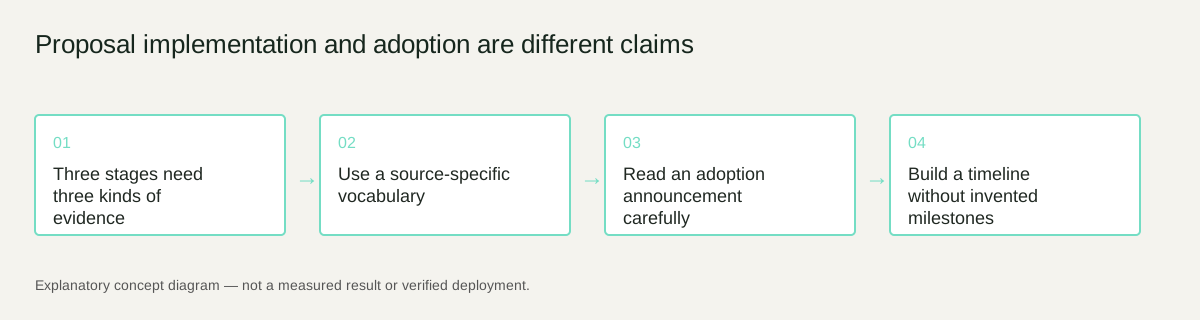
Three stages need three kinds of evidence
A written proposal describes an intended mechanism. An implementation shows that someone has built something corresponding to a design. Adoption concerns use within a stated population and period. These stages can overlap, but they should not be treated as interchangeable milestones.
Use a source-specific vocabulary
An improvement proposal can be a useful primary record of a technical idea. Its existence does not establish deployment. The ERC-8004 source is one example in which draft status must stay attached to the description. Broader claims about current use require implementation and usage evidence beyond the proposal page. [C05]
Read an adoption announcement carefully
Ask who measured use, what counted as a user or event and whether repeated activity was separated from distinct participants. If a source does not supply that information, do not manufacture a denominator. You can describe the announced figure as a source’s claim while explaining the unanswered measurement question.
Build a timeline without invented milestones
For a hypothetical technology, record a proposal date, a release record and a separately measured usage period only when each is available. Leave missing dates blank. A diagram with an attractive arrow should not imply a confirmed progression from idea to broad adoption.
Turn the distinction into a reading habit
Before writing “used”, “launched” or “standard”, ask what source supports that particular verb. A modest revision to one verb can prevent a substantial overstatement. Research benefits from distinguishing evidence stages even when the resulting headline becomes less dramatic.
Sources
- ERC 8004 Trustless Agents — Inspected page marked draft; no adoption claim.
- Introduction to smart contracts — General program model; not a deployment audit.
Sources and further reading
- Introduction to smart contracts ↗
General program model; not a deployment audit
- ERC 8004 Trustless Agents ↗
Inspected page marked draft; no adoption claim
Check the original document for its scope, date and current status.
Something needs a closer look?
Suggest a correction
